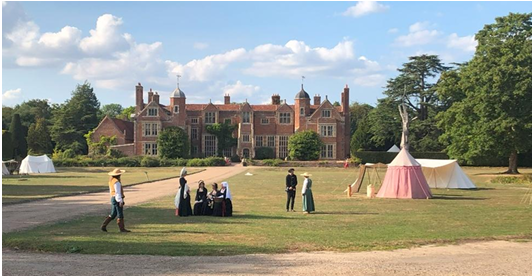
On Friday 15th August, a sunny, hot day, 32 of us joined the U3A Stanway/Colchester visit to the summer Tudor reenactment event at Kentwell Hall in Long Melford, Suffolk.
The year was 1536 and Henry VIII was ruling with his third wife, Jane Seymour.
We approached Kentwell, the ancestral home of the Clopton family, through a mile long avenue of ancient limes, flanked by sheep filled meadows. Passing through the large park gates, the entrance to the event, we looked out on a beautiful Elizabethan manor house, built of soft red brick, surrounded by a broad moat filled with carp and tench.
We were made welcome by a group of costumed re-enactors who wished us “good morrow” and enquired “from whence have ye journeyed, good mistresses and masters?”
Hearing Tudor music nearby, we noticed a group of musicians, all keen to tell us about the instruments they were playing. Our group members proceeded independently, taking their preferred routes to see the wide range of activities located within the house and its 24 acres of magnificent grounds.
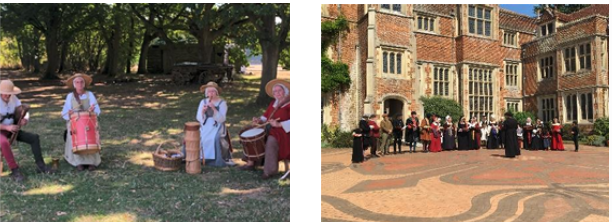
We had learnt that everyone was particularly busy as this was a special day – the day of the Feast of Assumption, which celebrates the taking of the Virgin Mary to heaven by the angels. The service for the Clopton family and their guests would be at 12 noon in the square fronting the house, heralded by the Angelus bell, when all work stopped on the estate and prayers were said at the many workplaces. The Cloptons and their guests would gather in the square in front of the house where the cleric would lead the service. Three Ava Marias would be sung, interspersed with prayers, translated for us by Lady Clopton.
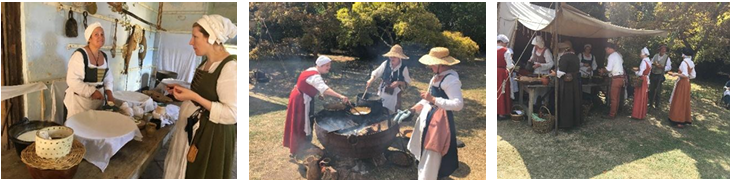
Inside the house, the kitchen was a hive of activity with the cooks preparing a feast for the family and guests. Pottage, a thick herb flavoured soup, made with vegetables and grains from the estate, was being stewed in a huge cauldron over the fire. The master cooks wore mainly white linen which could smoulder and not burst into flame if caught by the fire’s sparks, providing “the linen had not collected oil from greasy hands”! On a long wooden table, the traditional Friday fish dish was being prepared for the main course, along with a range of other courses and puddings, all to be paraded into the Great Hall later for the feast. The butcher was skinning rabbits in preparation for the Cloptons’ main meal the next day.
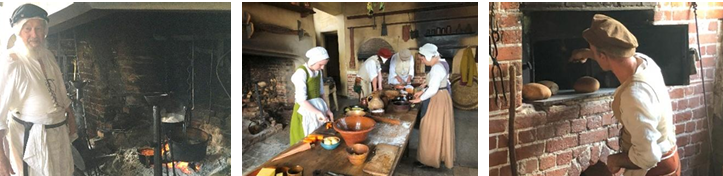
Meanwhile in the bakery, sited in the moat house next door, with its huge brick-built oven, the master baker was preparing common brown bread for the poor and white bread for the nobility.
There was plenty to interest us in the adjoining rooms: the cleric in his study preparing to lead the prayers for the Angelus service; a group of children playing card and board games; a music room with Lady Clopton leading others practicing Madrigals and needle women working on fine tapestries.
Outside in the grounds there was more to impress us, particularly: a yew topiary hedge depicting the Pied Piper of Hamelin story; a walled garden filled with ancient apple and pear trees; a camera obscura; a dairy and an ale house.
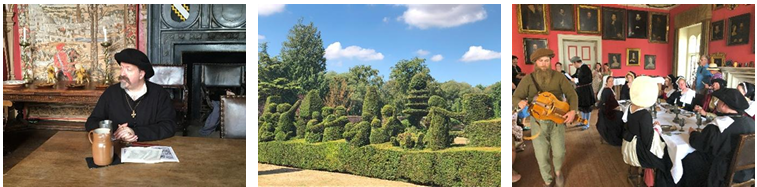
In the Great Hall after the Angelus service, the family and guests were seated listening to musicians, while their food was paraded in. The cleric led prayers before they ate and at the end, a visiting bard entertained them.
The workers after prayers hurried to the two food stations on the estate to “break their fast” – the first meal of the day after labouring in the fields or at their crafts. Served in clay bowls was a pottage, mainly of vegetables, a loaf of common bread with butter from the dairy and sometimes cheese made with goats’ milk.
Back to work in the grounds after watching the feast, we saw more of the Tudor skills. A group of alchemists startled us by the gunpowder explosions they created. Pottery grenades were made for battles. A purple liquid was being used to test the acidity or alkalinity of substances, prepared first from “lit moss”. Even soap was produced for the ladies.
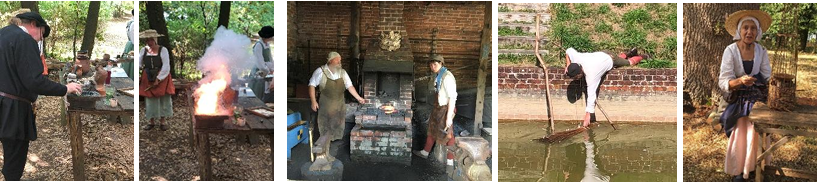
The master blacksmith was working in his forge, making tools and other metal objects for the Cloptons and their staff. His apprentice was learning the skills of his master, as well as pumping the huge bellows, to keep the furnace red hot.
Women were making eel baskets of willow which had been soaked in the moat for days to make it pliable; others were using bull rushes which they cleverly plaited to make hats and baskets; builders were repairing wattle and daub houses and out-buildings, also the great house itself, already over 500 years old was constantly in need of repair. There were archers practising accurate shooting with long bows. Women, in another building, having knowledge of herbs, were crushing some to be placed in pomanders to be worn around necks or hung in the houses to ward off diseases and even evil spirits. Many herbs were being distilled into “teas that could cure all ailments”. Others were spinning, weaving and dying fabrics, all with natural dyes such as madder for red, broom for yellow or brown and tan from walnut husks. A skilled potter was raising a perfectly shaped pot from her treadle wheel.
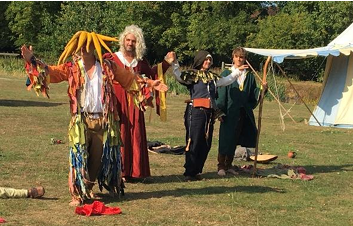
Finally, as we were leaving, some of us stopped near to the main gates to watch a group of travelling players performing a short comedy about Robin Hood, rounded off with music and dancing.
During and following the event, many of our group commented on how much they had enjoyed themselves and how fascinating it had been talking to the “Tudors” about their work, and indeed their lives in 16th century Kentwell. There was almost too much to see and explore in one tiring, but memorable day!
Barbara and Ron May
Special thanks to Christopher May for his help and support.